

Performance
• Measurement method: Combined infrared proximity detection and ultrasonic ranging in air• Resolution: 1 mm
• Detection / measurement range:
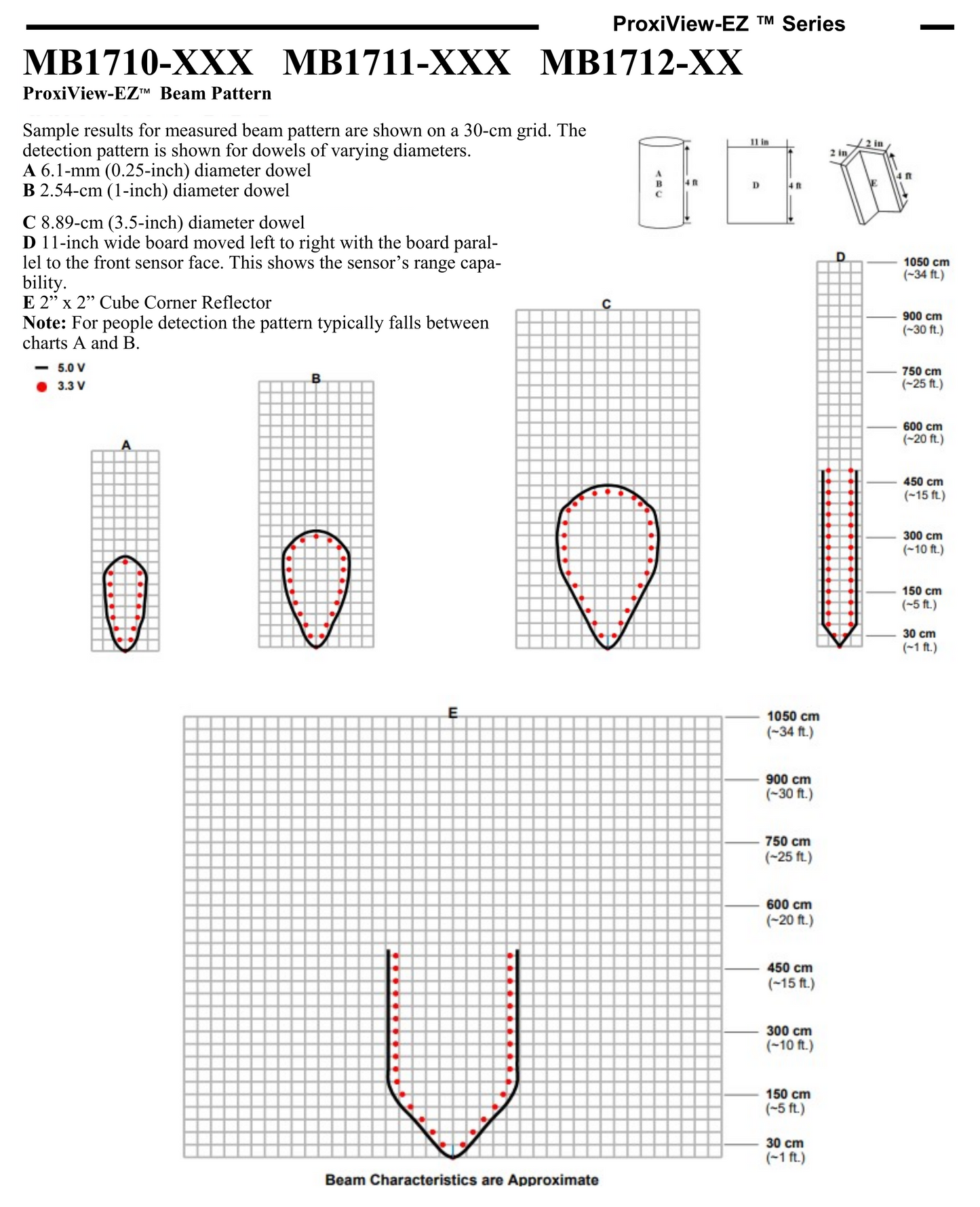
Proximity detection from the sensor face to approximately 30 cm
Ranging measurements from 30 cm to 5 m
• Ultrasonic frequency: 42 kHz
• Internal filtering for stable readings and rejection of small acoustic and electrical disturbances
• Auto-calibration on every reading with compensation for target size, temperature, and supply-voltage changes
Operating modes & update rate
• Free-run operation designed for indoor environments; continuous range reporting• Typical refresh rates:
MB1710: ~3.3 Hz
MB1711: ~3.3 Hz
MB1712: ~2 Hz
Interfaces & outputs (by model)
• MB1710 – USB-ProxiView-EZ: USB cable (Type-A or Type-C) presenting as a virtual COM port• MB1711 – MicroUSB-ProxiView-EZ: onboard Micro-B USB connector
• MB1712 – I2C-ProxiView-EZ: QWIIC connector with I2C interface
Electrical
• Low-voltage operation compatible with standard 5 V USB suppliesEnvironmental & mechanics
• Operating temperature: −40 °C to +65 °C when appropriate frost prevention is provided• Designed for protected indoor environments (kiosks, enclosures, and similar)
• Compact housing under 2 in³ with integral mounting holes
• Factory-calibrated beam patterns for consistent detection zones between sensors of the same model
Multi-sensor behavior
• Firmware supports simultaneous operation of multiple ProxiView-EZ sensors at the same frequency in the same area with reduced risk of cross-talk (installation geometry still influences performance)Specifications summarized above. See the Kiosk Sensor Combination Ultrasonic and IR Proximity Datasheet for complete electrical and mechanical details.
The ProxiView-EZ Series is designed for modern people-detection and occupancy-sensing tasks where you need dependable presence information in a very compact, USB-powered or I2C-connected form factor. Instead of focusing on raw measurements, it helps you answer practical questions like “Is someone here?”, “How close are they?”, and “How is traffic flowing through this space?”—making it well suited for interactive kiosks, self-service terminals, and smart building systems.
USB-based models are ideal when you want a simple “plug-and-sense” setup with a computer or kiosk controller. They appear as standard serial ports, so you can feed distance and presence data directly into applications, analytics dashboards, or automation logic with minimal integration effort. For embedded designs, the I2C variant fits neatly into microcontroller and single-board-computer projects, allowing multiple sensors to share a common bus in distributed or space-constrained installations.
By combining proximity sensing with ultrasonic ranging and built-in filtering, the ProxiView-EZ Series provides stable, application-ready data that is less affected by changes in clothing, color, or ambient conditions. Typical uses include triggering displays only when a person is present, managing queues and entrances, supporting energy-saving lighting and HVAC control, and enabling basic access-awareness features—all while keeping installation, wiring, and software integration straightforward.
Documents
ProxiView-EZ Line Kiosk Sensor CAD Files
- Coming Soon - Solid Works Part
- Coming Soon - STL File
- Coming Soon - STEP File
No PCNs on Record